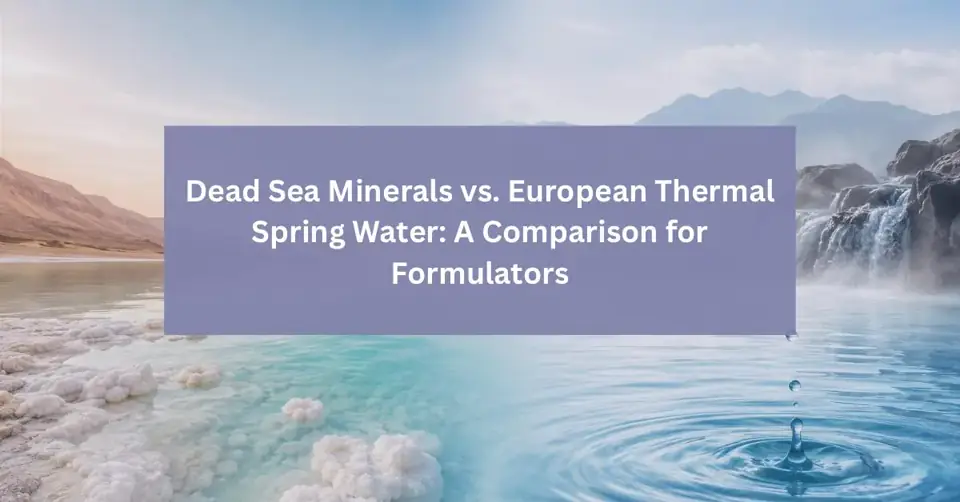
Dead Sea Minerals vs. European Thermal Spring Water: A Comparison for Formulators
European pharmacy shelves prominently feature product lines centered on thermal spring water from specific French sources. Brands like Avène, La Roche-Posay, Vichy, and Uriage have established “thermal spring water” as a recognized ingredient claim in skincare over decades.
Dead Sea minerals similarly occupy a significant niche in the natural ingredient market as a geographically distinct, mineral-rich source with established therapeutic reputation. However, comparing these two categories requires understanding their fundamental differences — they operate through distinct mineral concentrations, different mechanisms, and suit contrasting product formats.
What is European thermal spring water, exactly?
Thermal spring water originates as groundwater that naturally rises to the surface after slowly filtering through mineral-rich rock formations over extended periods — sometimes centuries. During this journey, the water accumulates trace minerals specific to the geology it traverses, creating each spring's distinct mineral signature.
These waters contain relatively modest mineral concentrations. This design enables liberal use in face mists, toners, or high-percentage formulation bases, appropriate for reactive, compromised skin without irritation risk.
What makes Dead Sea minerals different?
Dead Sea mud and salt represent the opposite end of the concentration spectrum. The Dead Sea is a landlocked, hypersaline body without natural outlets. Thousands of years of evaporation have concentrated its mineral content to approximately ten times ordinary seawater levels — including magnesium, calcium, potassium, sodium, bromide, and sulphate at concentrations far exceeding any spring water.
Dead Sea mud and salt function as active ingredients in masks, scrubs, bath salts, or spot treatments rather than as high-percentage liquid bases applied repeatedly to facial skin.
Side-by-side: formulation characteristics
| Characteristic | European thermal spring water | Dead Sea minerals (mud & salt) |
|---|---|---|
| Mineral concentration | Low to moderate | Extremely high — roughly 10x seawater |
| Typical form in formula | Liquid, used as base or high-inclusion ingredient | Solid/semi-solid mud or crystalline salt, used as active |
| Typical product formats | Face mists, toners, high-water-content creams | Masks, body scrubs, bath salts, spot treatments |
| Primary formulation role | Soothing, calming, antioxidant support | Detoxifying, exfoliating, mineral-intensive therapeutic action |
| Skin sensitivity profile | Formulated for daily, liberal use on reactive/compromised skin | Formulated for periodic, targeted, higher-intensity use |
| Geographic exclusivity | Multiple recognized European sources (France, Spain) | Effectively two sources worldwide — Jordan and the West Bank |
| COSMOS/Ecocert organic eligibility | Not certifiable as organic — “water” category | Not certifiable as organic — “minerals” category |
| REACH applicability | Applies as imported/manufactured substance in EU | Applies as imported/manufactured substance in EU |
The regulatory overlap formulators should know
Neither category can achieve “organic” certification under COSMOS standards. Water and minerals explicitly fall outside organic-eligible categories — organic certification requires agricultural origin, and neither a spring nor a hypersaline lake qualifies as farmland. Dead Sea ingredient brands should adopt the same “natural origin” positioning for the same underlying reasons.
Both categories remain subject to REACH compliance once imported into the EU above the one-tonne threshold. Geographic origin creates no compliance exemption — geography influences the mineral narrative, not regulatory obligations.
Positioning: gentle daily ritual vs. intensive mineral treatment
The clearest framework uses frequency and intensity rather than comparative superiority. Thermal spring water brands built their category around gentleness and daily repeatability. Dead Sea mud and salt occupy the inverse yet equally valid position: concentrated, periodic, intensive treatment. This explains why Dead Sea ingredients dominate detoxification, muscle recovery, and therapeutic skin condition categories where dilute thermal waters lack sufficient concentration.
A brand could reasonably incorporate both: a light mineral mist for daily application and a Dead Sea mud mask for weekly intensive treatment.
What this means for sourcing decisions
- Choose thermal spring water for gentle, daily-use, sensitive-skin-focused lines — toners, mists, hydrating bases.
- Choose Dead Sea minerals for intensive, treatment-focused, spa-positioned lines — masks, scrubs, bath salts, targeted therapeutic products.
- Combine both when building multi-step routines requiring gentle daily layers and concentrated intensive steps.
Sourcing Dead Sea minerals as a formulator
Working with Dead Sea mud and salt demands the same rigor as sourcing any concentrated mineral ingredient: verified mineral composition documentation, consistent batch purity, and reliable manufacturing supporting quality and regulatory paperwork.
Ashtar's manufacturing maintains ISO compliance, Cruelty-Free certification, and full approval from Jordan's Ministry of Health and the JFDA. We supply Dead Sea mud, salt, and related raw materials to European formulators, with composition data, sourcing documentation, and technical information required for compliance work, including REACH and COSMOS submissions for finished products.
Conclusion
Thermal spring water emphasizes gentleness and daily repeatability; Dead Sea mud and salt prioritize concentration and therapeutic intensity. For formulators, the optimal strategy is understanding each ingredient's functional suitability and sourcing accordingly rather than selecting one exclusively.