Clean Beauty in Europe: Where Dead Sea Ingredients Fit the Trend
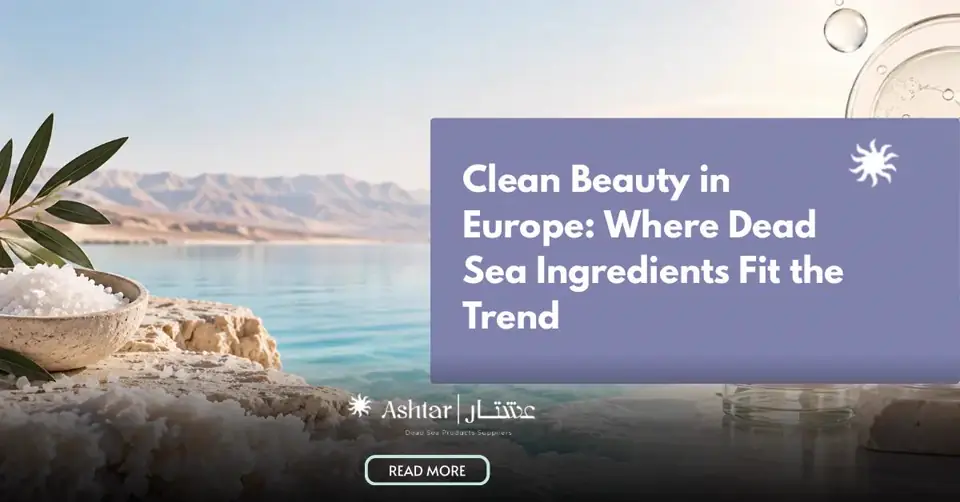
“Clean beauty” has moved from a niche shelf tag to one of the defining forces in European skincare. Consumers are reading ingredient lists before they read marketing copy, retailers are building entire vegan and sulfate-free sections, and brands that once leaned on vague naturalness claims are now expected to back them up with transparency, evidence, and traceable sourcing.
For a supplier of Dead Sea mud and salt, this shift raises an obvious question: does clean beauty actually favor Dead Sea ingredients — or does it demand a level of transparency the category hasn't always delivered? The honest answer is both. Dead Sea minerals fit the clean beauty story naturally, but only when brands communicate about them the way clean beauty actually requires: precisely, not just enthusiastically.
What “clean beauty” actually means in Europe right now
Clean beauty in Europe isn't a legally defined term — no single certification says “this is clean.” Instead, it's a consumer expectation built on several overlapping demands: formulas free of parabens, sulfates, and synthetic fragrance allergens; legible, honestly labeled ingredient lists; sourcing traceable to its origin; and, increasingly, proof rather than just claims.
That last point matters most. European consumers, particularly in markets like France and Germany, are no longer satisfied by “natural” as a standalone word on a label — they expect origin disclosure, recognized labels, and a coherent story behind the ingredient.
Where Dead Sea ingredients genuinely fit
- A single, traceable, geographically specific origin. Clean beauty consumers respond to sourcing stories they can point to on a map. The Dead Sea offers a real, singular, non-replicable origin — not a synthetic ingredient manufactured in a lab with no geographic story at all.
- Minimal processing. Dead Sea salt and mud are naturally occurring minerals, harvested and processed with minimal intervention. This aligns with the “ingredient minimalism” trend: shorter ingredient lists and formulas built around a small number of functional actives.
- No synthetic irritants by nature. Because the mineral content is naturally occurring rather than synthesized, Dead Sea ingredients avoid the categories of concern — parabens, sulfates, synthetic fragrance compounds — that clean beauty consumers screen out.
- Ethical and cruelty-free sourcing potential. A supplier able to demonstrate cruelty-free certification at the manufacturing level gives a brand one more verifiable claim to put on the label.
Where the category needs to be careful
“Natural” is not “organic.” No mineral ingredient — Dead Sea mud and salt included — can be certified organic under COSMOS. Clean beauty audiences are sophisticated enough to notice an “organic” claim that doesn't hold up, so the accurate positioning is “natural mineral origin,” not “organic.”
Clean beauty demands supply chain transparency, not just an origin story. It's not enough to say “sourced from the Dead Sea.” European buyers and end consumers expect sourcing documentation, environmental sourcing practices, and manufacturing standards behind the claim.
What genuine transparency looks like
- Verified manufacturing standards — ISO-compliant production and recognized regulatory approval at origin (in Ashtar's case, Jordan's Ministry of Health and JFDA approval).
- Cruelty-free certification, clearly stated and verifiable rather than implied.
- Accurate, non-inflated labeling claims — “natural mineral origin,” not “organic.”
- A transparent path to EU compliance — REACH documentation and support toward COSMOS or Ecocert certification for the finished product, from a supplier who is upfront about what they hold directly and what they help clients achieve.
Ashtar's own certifications — ISO-compliant manufacturing, Cruelty-Free certification, and JFDA/Ministry of Health approval — are held directly, and we're explicit with European partners about which additional certifications (REACH, COSMOS, Ecocert) apply to their finished product and how we support that process.
Why this matters for positioning, not just compliance
Clean beauty consumers have effectively become amateur auditors of ingredient claims. A brand that gets the “natural vs. organic” distinction right, is transparent about what's certified versus what's supported, and can point to real manufacturing standards behind its Dead Sea sourcing will outperform a brand leaning on evocative but unverifiable language — even if the underlying ingredient quality is identical.
Conclusion
Dead Sea minerals fit Europe's clean beauty trend genuinely well: a traceable single origin, minimal processing, no synthetic irritants, and real potential for cruelty-free and ethically sourced positioning. But fitting the trend only pays off if brands communicate about the ingredient with the same precision clean beauty consumers apply to everything else on the label — natural, not organic; certified where it's actually certified; supported where it's in progress.